Dent line
Paintless Dent Repair
Minor dents and dings restored without repainting, preserving the factory finish.
Chapter 01
Which dents can come out and which cannot
Paintless repair works on one condition: the paint has to still be whole. A shopping-cart ding in a door, a round dent where a hailstone landed, a soft crease along a fender from a branch. Metal remembers its shape, and if the paint has not cracked or lifted, the metal can be coaxed back without touching the finish above it.
Hail is the clearest case. One Google reviewer brought in a vehicle where every panel contained multiple dents, and the work was finished quickly and well. Hundreds of small round dents are exactly the job paintless methods suit, because refinishing every panel on a hail-struck truck would cost far more time and leave far more paint to match.
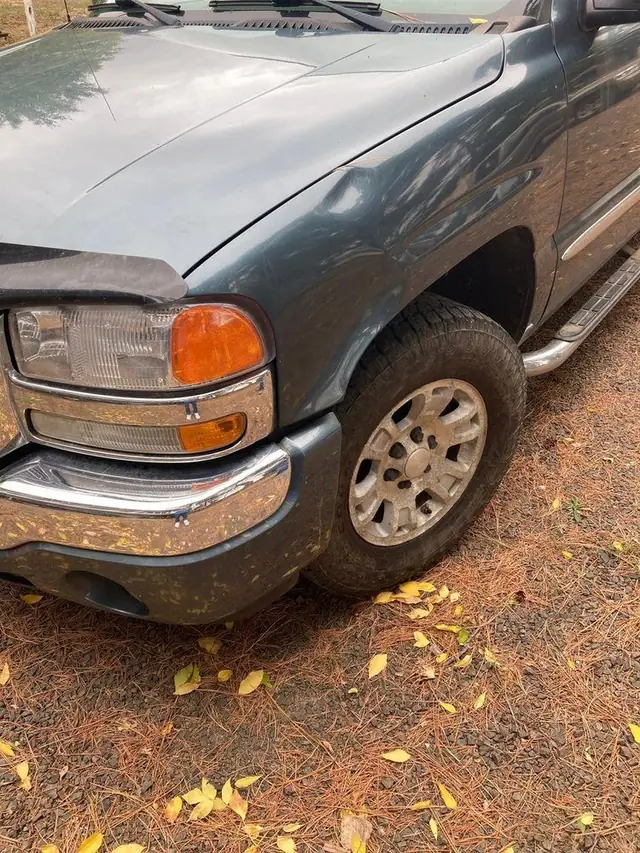
Slate GMC Sierra front quarter, finished, parked on autumn pine needles
Pushed from behind, read in the reflection
The work happens from the back side of the panel. A door gets its trim and sometimes its inner liner pulled so a slim steel tool can reach in behind the dent. Then it is a matter of small, patient pushes, each one moving the metal a fraction of a millimeter, while a light board or a lamp throws lines across the panel so the repairer can read the surface the way you read a pond.
A dent shows up in those reflected lines as a bend or a gap in the pattern. The job is finished when the lines run straight again from edge to edge. No filler goes in, no sanding, no primer, and nothing needs matching afterward because the paint on the panel is the paint the vehicle left the factory with. That is why Brad uses paintless techniques whenever the damage allows.
Chapter 03
When a dent says no to paintless
Some damage is out of reach of any tool. A dent on a sharp body line, a crease where the metal has stretched, a spot with a double-thick edge, or a panel with a cracked or chipped paint line all need conventional repair. Aluminum panels and the pinched outer edge of a door can also resist, because the metal there does not move the way a flat steel skin does.
The honest way to find out is to look at it in good light. Bring the vehicle to 1926 US-95 in Council, or call (208) 250-7787, and Brad can say whether it is a paintless job, a conventional body repair, or a mix of both. When insurance is involved, as it often is with hail, he works with the company on the claim.
From a Google review: “Brad made significant repairs to my hail damaged vehicle (every panel contained multiple dents)”
If the dent says no
Not every ding qualifies. These are where the damage goes when paintless will not reach it.