Bumper bench
Bumper Repair
Fix cracks, dents and scuffs with seamless color-matched finishes.
Chapter 01
A bumper cover is plastic, and plastic hides its damage
What most people call the bumper is a painted plastic cover stretched over a reinforcement bar and an energy absorber. The cover is built to flex and take a scrape, so a parking-lot tap or a deer clipping the corner on US-95 often leaves something that looks like a scuff. Under it there can be a cracked mounting tab, a split along the lower edge, a pushed-in corner that no longer lines up with the fender, or a fog lamp bracket that let go.
Scuffs, scrapes, tears and cracks are all different repairs. A scuff is a paint problem. A tear or crack is a structural problem in the plastic itself, and painting over it only hides it until the cover flexes again. The first thing worth doing is getting the cover off the truck or car and looking at the back, where the real damage usually shows.
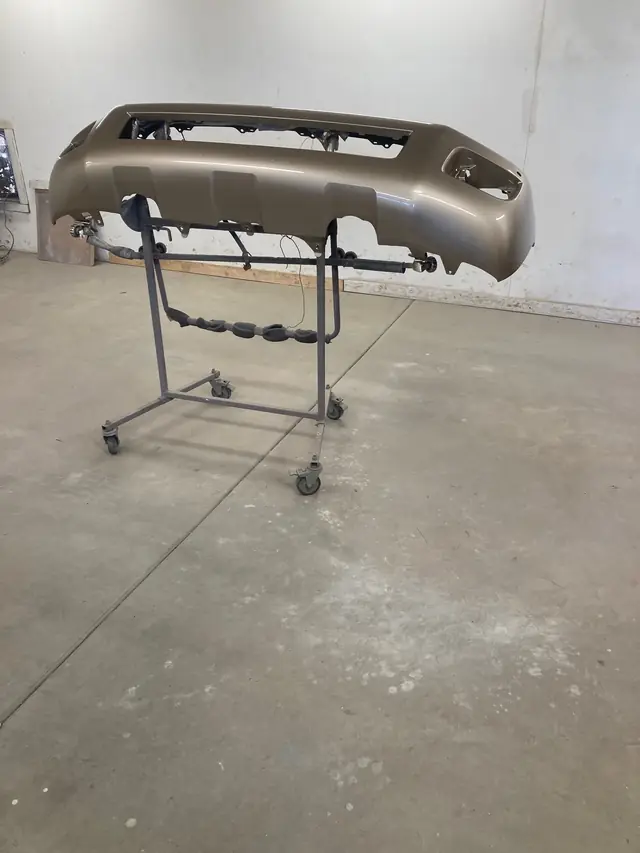
Tan bumper cover on a paint stand in an empty bay
Repair it or replace it: the call gets made on the bench
Once the cover is off the vehicle, the decision is practical. A clean crack or a torn edge can be welded and reinforced from behind, built up with filler, sanded back to the original shape and primed. A cover that has been crushed, stretched or split in several places is usually cheaper and straighter as a new part, and Brad has access to more than one source for parts, as one New Meadows customer noted in his review.
Either way, the finish is where a bumper job is won or lost. Bare plastic needs an adhesion promoter and a flex additive in the coating so the paint moves with the cover instead of cracking on the first cold morning. Then comes the color match. Brad lays down the basecoat and clear in the booth at the shop on US-95 and blends it so the bumper does not read as a different shade from the fenders beside it.
Chapter 03
What sits behind the cover matters more than the cover
Modern bumpers carry more than paint. Behind the cover there can be parking sensors, a radar module, a camera bracket, tow hooks and a run of clips that hold the whole thing to the fenders. A repair that looks right from ten feet can still leave a sensor aimed at the ground because a bracket sat a few degrees off when the cover went back on.
Before a vehicle leaves, the gaps along the fender and hood edges get checked, the lamps and sensors get checked, and the absorber behind the cover gets a look for the kind of crushing a cover never shows. If it is a hit that went past the plastic, the job moves toward collision work and the insurance paperwork that goes with it. Call (208) 250-7787 and bring the vehicle by 1926 US-95 in Council, Monday to Friday, and Brad can tell you which side of that line it falls on.
From a Google review: “he is very skilled at what he does, he has access to multiple places for OEM parts”
Next to the bumper
A bumper hit rarely stays in the bumper. These are the jobs it usually runs into.